

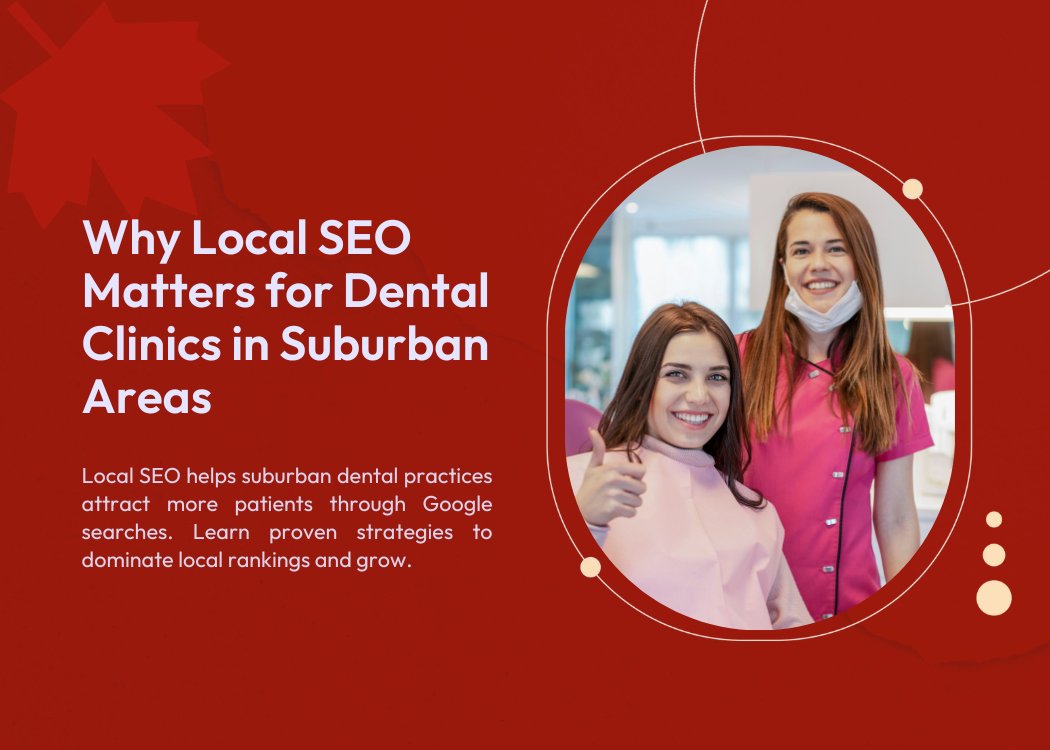
Finding a dentist used to be simple. You’d ask neighbors or flip through the Yellow Pages. Not anymore.
Today, 71% of patients search online before booking dental appointments. And 90% of those local searches turn into actual visits or calls. If your suburban dental practice isn’t showing up in these searches, you’re losing patients every day.
Suburban dental clinics sit in a sweet spot. You’re not fighting dozens of competitors like downtown practices. But you also can’t rely on being the only option like rural clinics.
This middle ground creates real opportunities for practices that understand local SEO.
Pro Tip: Don’t let competitors capture your local patients while you’re still figuring out SEO. Get expert help to boost your local rankings and drive more qualified leads with tailored local SEO services designed for Canadian dental practices.
What Is Local SEO for Dentists?
Local SEO helps your dental practice show up when people search for dentists in your area. It’s different from regular SEO in one key way: location matters more than anything else.
Regular SEO might help you rank for “tooth whitening tips.” Local SEO gets you found for “dentist near me” or “tooth whitening in [your city].”
Here’s what local SEO includes:
- Google Business Profile optimization – Your digital storefront
- Local keyword targeting – “Dentist in [city]” searches
- Online reviews management – Building trust with patients
- Citation building – Listing your practice on directories
- Location-based content – Blog posts about your community
The numbers tell the story. 46% of all Google searches are local. And 88% of local mobile searches lead to action within a week. That action could be calling your office or visiting a competitor.
Why Location-Based Businesses Need Local SEO
Local businesses live or die by their community presence. This is especially true for dental practices.
Think about how people choose dentists. Location tops the list every time. Patients want convenience. They want a dentist close to home or work. And they want to find that dentist fast when they’re in pain.
Voice search makes this even more important. 58% of people now use voice search to find local businesses. They’re asking their phones: “Hey Google, find me a dentist nearby who’s open today.”
These searches are urgent. People don’t browse multiple pages of results. They pick from the top few options that show up. If you’re not there, they’ll never know you exist.
Suburban areas have their own challenges:
- Patients might drive from several nearby towns
- Competition comes from multiple directions
- Community connections matter more
- Word-of-mouth still carries weight
Local SEO helps you capture all these advantages while reaching patients you’d never meet otherwise.
How SEO Helps Your Dental Practice Grow
SEO brings qualified patients to your door. But it does more than just increase website traffic.
Here’s the real impact:
- Better patient quality. People who find you through search are already looking for dental care. They’re not just browsing. They need what you offer.
- Lower marketing costs. SEO costs less than ads over time. Once you rank well, you get ongoing traffic without paying for each click.
- Builds trust. Patients trust businesses that show up first in search results. Good rankings signal credibility.
- 24/7 marketing. Your optimized website works while you sleep. Patients can find you and book appointments anytime.
- Competitive advantage. Most dental practices still don’t do SEO well. Getting ahead now means staying ahead.
The results speak for themselves. Take The Little Tooth in Saskatoon – our Freelancers HUB Canada team worked with them to achieve 32% traffic growth and 35.71% keyword growth in just 6 months through strategic local SEO.
Their organic search now dominates 69.76% of their total traffic, bringing qualified patients directly to their practice.
You can see the complete case study here to understand how our targeted optimization drives real results for dental practices.
The Suburban Advantage (And Challenge)
Suburban dental practices have unique opportunities. But they also face specific challenges that urban and rural practices don’t.
The Opportunities
- Multiple service areas. You can target several nearby communities instead of just one neighborhood. Patients will drive 5-10 miles for good dental care.
- Less competition. You’re not fighting 50 other dentists in a two-mile radius like downtown practices.
- Community focus. Suburban patients value local connections. They want to support neighborhood businesses.
- Family-oriented. Suburban areas skew toward families. That means multiple patients per household and long-term relationships.
The Challenges
- Scattered patient base. Your patients come from multiple towns and school districts. You need broader keyword targeting.
- Competition from multiple directions. Urban practices with bigger budgets might target your area. Rural practices might offer lower prices.
- Higher expectations. Suburban patients often have more disposable income. They expect modern websites and online booking.
- Community reputation matters. Bad news travels fast in tight-knit communities. Online reviews carry extra weight.
What Patients Actually Search For
Understanding patient search behavior changes everything about your SEO strategy.
The most common dental searches tell a clear story:
| Search Term | Search Volume | Intent |
| “dentist near me” | Very High | Finding any local dentist |
| “emergency dentist” | High | Urgent care needed |
| “family dentist” | High | Long-term care for household |
| “dental implants in ontario” | Medium | Specific treatment research |
| “cosmetic dentist” | Medium | Aesthetic procedures |
But here’s what’s interesting. The search patterns change based on device and time:
Mobile searches (60% of traffic):
- Focus on immediate needs
- Location and hours matter most
- “Open now” searches spike after 5 PM
- Emergency searches peak on weekends
Desktop searches (40% of traffic):
- More research-oriented
- Treatment comparison shopping
- Insurance verification
- Reading reviews in detail
Voice searches are growing fast. These sound different:
- “Find me a good dentist within 10 miles”
- “Which dentist near me takes my insurance?”
- “What dentist is open on Saturday?”
Understanding these patterns helps you create content that matches what patients actually want to know.
Google Business Profile: Your Digital Front Door
Your Google Business Profile might be the most important part of your online presence. It’s often the first thing patients see when they search for local dentists.
The average business is found in 1,009 searches per month, with 84% of verified profiles getting found through discovery searches. That means Google shows your practice to people who weren’t even looking for you specifically.
Essential Profile Elements
- Complete business information. Name, address, and phone number must match exactly across all platforms. Even small differences confuse Google’s systems.
- Professional photos. Include your office exterior, waiting room, treatment rooms, and staff. Practices with photos get 42% more requests for directions and 35% more clicks to their website.
- Accurate categories. Choose “Dentist” as your primary category. Add specific services like “Cosmetic Dentist” or “Pediatric Dentist” as secondary categories.
- Business hours. Keep these updated, especially for holidays. Nothing frustrates patients more than driving to a closed office.
- Services list. Detail what you offer. Include common treatments like cleanings, fillings, and crowns. Add specialized services that set you apart.
Managing Reviews and Questions
Reviews make or break local rankings. Google uses review quantity, quality, and recency as ranking factors.
The stats are clear:
- 90% of patients read reviews before choosing a dentist
- 77% use reviews as their first step in finding dental care
- It takes 1–6 reviews for potential patients to form an opinion about a practice.
- Minimum 3-star rating required by 42% of patients
Here’s how to manage reviews systematically:
- Ask every patient. Send review requests 24-48 hours after appointments
- Respond to everything. Thank positive reviewers. Address negative feedback professionally
- Stay HIPAA compliant. Never mention specific treatments or patient details
- Monitor multiple platforms. Focus on Google (60%), Yelp (25%), and Facebook (15%)
The Q&A section gets overlooked, but it’s valuable. Patients ask about insurance, parking, emergency hours, and services. Answer these quickly and thoroughly.
Technical SEO Fundamentals That Matter

Technical SEO might sound complicated, but the basics are straightforward. Get these right and you’re ahead of most dental practices.
Website Speed and Mobile Optimization
53% of mobile users abandon sites that take longer than 3 seconds to load. For dental practices, this means lost appointments.
Mobile optimization isn’t optional anymore. 64.35% of dental website traffic comes from mobile devices. Google ranks mobile-friendly sites higher in search results.
Check your site speed at PageSpeed Insights. Aim for scores above 90 on mobile. Common speed killers include:
- Large, uncompressed images
- Too many plugins
- Slow hosting providers
- Outdated website platforms
Having a properly optimized dental website is crucial for converting visitors into patients and maintaining competitive rankings.
Local Schema Markup
Schema markup helps Google understand your business details. It’s code that tells search engines you’re a dental practice, where you’re located, and what services you offer.
Essential schema types for dental practices:
- LocalBusiness/Dentist
- MedicalOrganization
- Service (for specific treatments)
- Review aggregation
Most website platforms have plugins that add schema automatically. If you’re not sure whether yours is set up correctly, check with your web developer.
SSL Certificates and Security
Google requires SSL certificates for all medical websites. These show the lock icon in browsers and encrypt patient data.
Beyond security, SSL certificates are a ranking factor. Sites without them rank lower and show “Not Secure” warnings that scare patients away.
Building Local Citations and Directory Listings
Citations are mentions of your practice name, address, and phone number on other websites. They work like references for your business.
Google uses citations to verify your practice exists and serves your claimed location. More citations from relevant, high-quality sites improve your local rankings.
Citation Priorities
Tier 1 – Essential platforms:
- Google Business Profile
- Bing Places for Business
- Apple Maps
- Yelp
- Facebook Business
Tier 2 – Healthcare directories:
- Healthgrades
- Vitals
- WebMD Provider Directory
- Zocdoc
- Wellness.com
Tier 3 – Local directories:
- Yellow Pages
- Chamber of Commerce
- Better Business Bureau
- Local newspaper directories
- Community websites
Consistency Is Critical
NAP consistency (Name, Address, Phone) across all platforms is crucial. Even small differences confuse search engines and can hurt rankings by up to 70%.
Common consistency mistakes:
- Using “Dr. Smith’s Dental Office” on some sites and “Smith Dental” on others
- Including suite numbers inconsistently
- Different phone number formats
- Abbreviating “Street” as “St.” on some listings but not others
Managing citation accuracy across hundreds of directories requires systematic tracking and updates.
Our professional SEO services handle this time-consuming process while ensuring your practice information stays consistent everywhere it appears online.
Content Strategy for Local Dental SEO
Content marketing for dental practices works differently than other industries. You’re building trust with people who need medical care, not selling products.
Topics That Work
Local community focus:
- “Dental Health Tips for [City] Families”
- “Why [City] Residents Choose Our Practice”
- “Supporting [Local School District] Sports Teams”
Treatment education:
- “What to Expect During Root Canal Treatment”
- “Dental Implants vs. Dentures: Complete Guide”
- “Children’s Dental Care: Ages 2-12”
Practice updates:
- New technology announcements
- Staff introductions
- Office renovation updates
- Community event participation
Regular blogging helps establish your practice as a trusted authority in your community.
Avoiding Common Content Mistakes
- Don’t copy content. Google penalizes duplicate content heavily. Write original articles or hire professional writers.
- Don’t keyword stuff. Include location terms naturally. “Best dentist in [city]” repeated 20 times hurts more than it helps.
- Don’t ignore patient questions. Address real concerns patients have. Check your review comments and phone calls for content ideas.
- Don’t forget to update. Old, outdated content signals to Google that your site isn’t maintained. Update at least monthly.
Creating consistent, high-quality content takes time and expertise.
At Freelancers HUB Canada, our digital content marketing services help dental practices develop engaging blog posts, patient education materials, and community-focused content that builds trust while improving search rankings.
Common Local SEO Mistakes to Avoid for Dental Practices
These mistakes cost dental practices thousands of patients every year. Avoid them and you’re ahead of most competitors.
1. Neglecting Google Business Profile
70% of local search visibility comes from your Google Business Profile. Yet many practices treat it like an afterthought.
Common mistakes:
- Incomplete business information
- Generic business categories
- No photos or low-quality images
- Ignoring patient questions
- Inconsistent posting schedule
2. Inconsistent Business Information
Different business names, addresses, or phone numbers across platforms confuse search engines. This single mistake can cut your local rankings in half.
Always use identical formatting:
- Business name: “Smith Family Dentistry” everywhere
- Address: “123 Main Street, Suite 100” (not “123 Main St #100”)
- Phone: “(555) 123-4567” with consistent formatting
3. Ignoring Mobile Users
As most of the dental website traffic comes from mobile devices. Sites that don’t work well on phones lose more than half their potential patients.
Mobile optimization means:
- Fast loading speeds (under 3 seconds)
- Easy-to-read text without zooming
- Clickable phone numbers
- Simple navigation menus
- Online appointment booking
4. Poor Review Management
Reviews drive local rankings and patient decisions. Ignoring them means losing both.
Systematic review management includes:
- Automated review requests after appointments
- 24-48 hour response times to all reviews
- Professional responses to negative feedback
- Regular monitoring across all platforms
The Future of Local SEO for Dental Practices
Local SEO continues evolving. AI integration and voice search are changing how patients find dental care.
Google’s AI Overviews now appear above traditional search results for many health queries. Practices featured in these AI-generated summaries get prime visibility. Others lose traffic.
Voice search keeps growing. These conversational queries require different optimization approaches. Instead of “dentist Springfield,” patients ask, “What’s the best dentist near me that takes Blue Cross insurance?”
The practices that adapt early gain lasting advantages. Simple changes like answering common questions clearly and optimizing for natural language patterns can capture this growing search volume.
Getting Started Today
While you’re figuring out local SEO, your competitors are already capturing patients who should be calling your practice. Every day you wait is another day of lost appointments.
Local SEO requires ongoing effort and technical knowledge. Many successful practices outsource this work to focus on patient care – and they’re seeing the results, while others fall behind.
Professional SEO services typically cost between $1,200 and $6,000 per month for dental practices.
Comprehensive packages usually run $2,000-$4,000 monthly and include:
- Complete website optimization,
- Google Business Profile management,
- Citation building,
- Review monitoring,
- Content creation, and
- Monthly reporting.
If you’re in Canada, Freelancers HUB Canada specializes in dental practice marketing. We offer both general SEO services for local businesses and specialized local SEO services for dentists.
Don’t let another month slip by – contact us today to discuss how we can help your practice dominate local search results before your competition does.
The window is closing. Your competitors aren’t waiting. The time to start is now.
